Can multiple leaves mixed together be dried simultaneously
Multiple types of leaves can be mixed and sent to a microwave tunnel oven for synchronous drying, but not all ...
About Production Shipment
For conventional customized equipment, we will complete the production in 7-15 days, the equipment could be shipped after your confirmation.
If available, it can be delivered directly.
Service commitment
After the arrival of the equipment, we will assign professional after-sales personnel to go to site for installation, guidance, commissioning, training, etc.
For those equipment cannot be installed on site, we will provide one-to-one video guidance for installation.
After sales service commitment
Within the agreed warranty period, all components of the equipment will be provided free of charge. Provide lifelong technical maintenance and repair services.
Tel:+86 53188965205
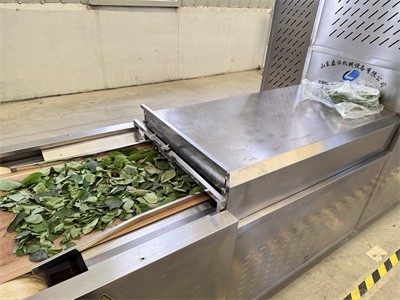
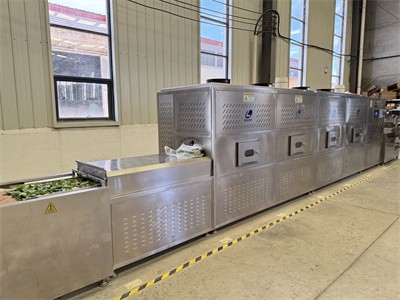
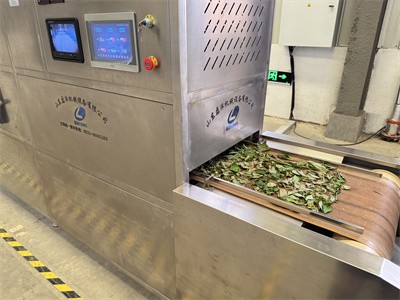
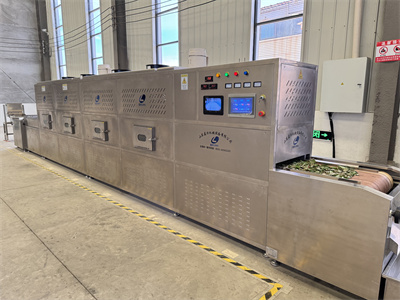
Multiple types of leaves can be mixed and sent to a microwave tunnel oven for synchronous drying, but not all blade combinations are suitable for mixed drying. Only by meeting the three conditions of matching raw material properties, proper pre-treatment in the early stage, and adapting process parameters can we balance drying uniformity, finished product quality, and production safety. Once the combination is not reasonable, it is easy to cause problems such as partial leaf burning, excessive moisture content, loss of aroma, and blackening of color.
Microwaves rely on the absorption of energy by water molecules inside the material to achieve overall heating. There are differences in blade thickness, initial moisture content, tissue structure, and heat resistance, which are the core reasons for the effectiveness of mixing and drying. Therefore, it is recommended to choose blade combinations with similar characteristics.
Fresh thin and tender leaves, thick leaves with large leaves, and semi dried leaves that have been air dried should not be mixed together. The dehydration cycle of high moisture content leaves is longer. At the same conveying speed, thin leaves are prone to dehydration, overheating, and carbonization first, while thick leaves cannot fully discharge the internal moisture, resulting in moisture regain and mold growth after discharge. Additionally, it should be noted that heat sensitive blades should not be mixed with high tolerance blades for processing in the same furnace.

If the production demand allows for mixed material processing, the first step is to sort the mixed blades in advance, removing coarse and hard branches, rotten and damaged blades; When there is a significant difference in moisture content, high moisture leaves should be pre dried and dehydrated in advance to reduce the overall moisture difference of the raw materials; The leaves should be fully dispersed to avoid clumping and clumping.
In addition, the materials should be evenly spread out as much as possible, and it is forbidden to stack them in large areas or excessively thick in some areas, to ensure that microwaves can penetrate the entire layer of materials evenly; Ensure smooth fabric throughout the feeding process, stable feeding volume, and avoid fluctuations in field strength caused by empty conveyor belts and uneven material density.








 QQ
QQ