On April 2, 2025, the EU published Regulation (EU) 2025/660 in its Official Gazette, amending the provisions on polycyclic aromatic hydrocarbons (PAHs) in clay targets in Annex XVII of REACH Regulation (EC) No 1907/2006), adding Item 50a to restrict the use of polycyclic aromatic hydrocarbons (PAHs) in clay targets for shooting. This provision will take effect on the 20th day after the publication in the EU Official Gazette and will be officially implemented on April 22, 2026.
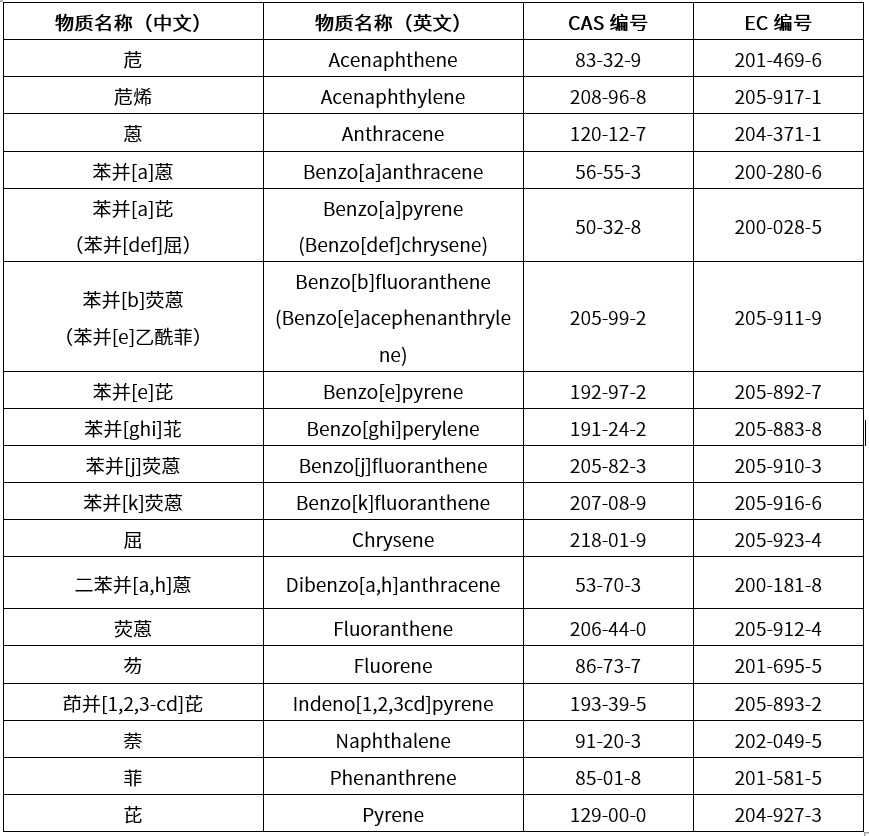
The information on restricted substances in the newly added Article 50a is as follows
Restriction requirements
From April 22, 2026, the above-listed polycyclic aromatic hydrocarbons (PAHs), whether used alone or as components of other substances, shall not be placed on the market or used for shooting purposes as long as their total content in clay targets exceeds 50 mg/kg (0.005% of the dry weight of the clay target).
About polycyclic aromatic hydrocarbons (PAHs)
Polycyclic aromatic hydrocarbons (PAHs for short) are a class of organic compounds widely present in the environment, composed of two or more benzene rings. They are a class of compounds with carcinogenic and reproductive toxicity, are biodegradable and accumulative, and are widely distributed. PAHs can cause damage to the human respiratory system, circulatory system, liver, kidneys and nerves. People who are in an environment contaminated by PAHs for a long time may cause cancer, damage human fertility or unborn babies.
As a widely used organic compound, PAHs are commonly found in lubricant additives, rubber softeners, rust inhibitors, plastics and rubber industries. They are also often used as plasticizers and softeners, or in some products used as clay target adhesives.
Warm Tips
With the continuous update of Annex XVII of the REACH Regulation, companies are facing more and more control requirements. ZRLK recommends that relevant companies improve their product risk awareness, pay attention to the updates of the REACH Regulation in a timely manner, adjust production strategies, ensure that the export of products containing restricted substances meets the latest regulatory control requirements, and avoid trade risks. Our company has a professional technical team and rich experience in product testing, which can help you easily understand whether the product is safe and compliant. If you need it, please feel free to contact us, and our engineers will serve you as soon as possible!