In recent years, with the rapid development of industry, regional atmospheric environmental problems such as acid rain, haze and photochemical smog have become prominent in some areas of our country. In order to effectively strengthen the control of air pollution, on July 3, 2018, the State Council issued the "Three-Year Action Plan for Winning the Blue Sky War".

The plan proposes a special rectification plan for the implementation of VOCs, including:
■ The construction, production and use of solvent-based coatings, inks, and adhesives with high VOCs content are prohibited in key areas;
■ Carry out special law enforcement actions for the rectification of VOCs, severely crack down on illegal pollutant discharges, and publish lists and implement joint punishments for governance units with poor governance effects, weak technical service capabilities, and low operational management levels;
■ Support and foster large-scale leading enterprises in VOCs governance and service specialization.
In order to cooperate with the development of related work, the state has strengthened and accelerated the formulation of VOCs emission standards.
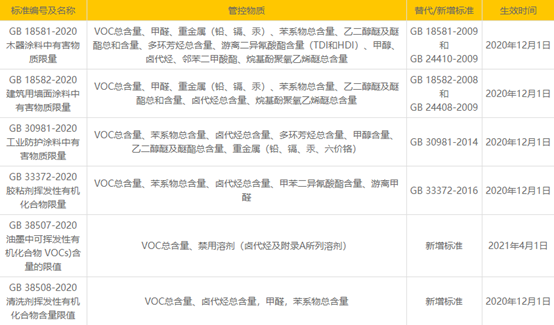
On March 4, 2020, the State Administration for Market Regulation (National Standardization Administration) approved 7 national mandatory standards including the "Limits of Hazardous Substances in Wood Coatings", which regulates the testing methods for VOCs in automobiles, coatings, adhesives, inks and cleaning agents And content limits, some of the new standards will replace the old standards. The issuance of the national mandatory standards will help reduce the application of VOCs in products and further help build my country's VOCs source prevention and control system.
VOCs related mandatory standards
Popular Science|Things about VOCs
VOCs definition
VOCs are volatile organic compounds. It is the abbreviation of the first letter of the three words Volatile Organic Compounds. Because the Chinese name and English name are relatively long, it is customary to use "VOCs" or "VOC" for short; TVOC is the total volatile Abbreviation for "Total Volatile Organic Compounds", which means total volume. According to the definition of the World Health Organization, it is a compound with a boiling point of 50°C-250°C, a saturated vapor pressure of more than 133.32Pa at room temperature, and a type of organic matter that exists in the air in the form of vapor at room temperature.
What are the main substances contained in VOCs?
According to the chemical structure of volatile organic compounds (VOCs), they can be divided into 8 categories: alkanes, alkenes, aromatic hydrocarbons, halogenated hydrocarbons, esters, aldehydes, ketones and other compounds. Common VOCs include benzene, toluene, xylene, styrene, dichloromethane, chloroform, dichloroethane, trichloroethane, trichloroethylene, methanol, acetone, ethyl acetate, etc.
Main sources of VOCs
Outdoors, it mainly comes from industrial waste gas, automobile exhaust, photochemical pollution, etc. from fuel combustion and transportation; while indoors, it mainly comes from combustion products such as coal and natural gas, smoke from smoking, heating and cooking, construction and decoration materials, Emissions from furniture, household appliances, detergents and the human body.
The harm of VOCs
There are many types of VOCs and their components are complex. Most of them have the characteristics of volatile and pungent odor. For example, formaldehyde, polycyclic aromatic hydrocarbons, dioxins, etc. have strong biological toxicity such as teratogenic, carcinogenic, and mutagenic. Some halogenated hydrocarbons and nitrogen and oxygen compounds are also toxic. People are exposed to VOCs through breathing and skin contact, which can cause headaches, nausea, coma, and convulsions. In severe cases, they can even damage the internal organs, brain and nervous system of the human body.
VOCs detection
At present, the common analysis of volatile organic compounds includes gas chromatography (GC), gas chromatography/mass spectrometry (GC/MS), flame ionization detector (FID), high performance liquid chromatography (HPLC), Fourier transform infrared spectroscopy (FTIR), ion chromatography, etc.
ZRLK warmly reminds: Green, environmental protection and sustainable development are the themes and the only way for today's social and economic development. Related production and trading companies such as automobiles, coatings, adhesives, inks, and cleaning agents should pay attention to the development of relevant regulations and standards, and pay particular attention to several mandatory national standards that will be implemented to limit the content of VOCs in products.