Puffed foods such as corn balls, popcorn, Prawn cracker have become popular snacks with their fluffy and crispy taste, and crispness is the core key to determine product quality and consumer reputation. In industrial mass production, most manufacturers encounter common problems: the moisture content of puffed and seasoned products does not meet the standard before packaging, leaving hidden moisture, resulting in sticky texture, insufficient brittleness, and even softening, moisture regain, deterioration, and clumping shortly after storage, seriously affecting product quality and shelf life.

The core root of such quality issues lies in the special porous and loose structure of puffed foods. After the material is expanded and formed, a large number of micro pores and gaps are formed inside, which easily hide residual moisture. Traditional processing often uses methods such as hot air drying and electric heating drying for dehydration. These processes rely on the principle of heat conduction through external heat and internal heat transfer, and heat can only slowly penetrate from the surface of the material inward. This is also the main reason for the sticky teeth and uneven taste of puffed foods.

In view of the drying pain points of puffed food, the microwave tunnel oven subverts the traditional drying mode by virtue of the penetrating drying technology, and perfectly adapts to the post dehydration process of various puffed food such as corn balls, popcorn, Prawn cracker slices, etc. Its core advantage lies in the overall dehydration logic from the inside out. High frequency microwaves can directly penetrate the entire material, activate the high-frequency vibration and friction of internal water molecules to generate heat, and synchronize the heating and vaporization of water inside and on the surface of the material. This fundamentally eliminates the problems of external dryness and internal wetness, as well as incomplete drying.
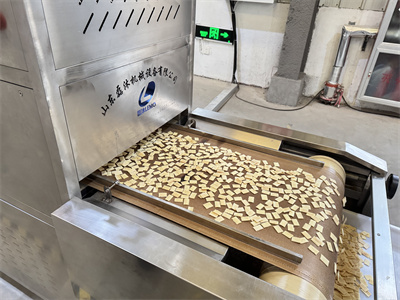
Compared to traditional processes, microwave tunnel ovens have significantly increased drying speed without the need for preheating. Materials can be dried and processed in just a few seconds through the equipment chamber, with drying efficiency far exceeding traditional processes. They can seamlessly connect with puffing, seasoning, and packaging production lines, achieving 24-hour continuous production and greatly improving enterprise production capacity.


 QQ
QQ